 S & T Notes - issue 139
 S & T Notes - issue 139

The faulty length of cable has been dug out, ready for replacement.
SIGNALLING NOTES - Chris. Hall
The Santa trains are running as I start drafting this article, hoping that it will be ready
by the time issue 138 appears, as that usually means the Editor will be asking for copy.
Fortunately this proved less of a challenge as I was still tinkering with the
article in mid January - these notes therefore cover the period from early
November to mid-February.
A training day covering track circuit testing was held in November, the first of a series
of 'mutual improvement' activities, the second of which was held in February ('deluxe'
mechanical maintenance).
We will all take turns to share our
personal areas of experience with the group and written notes will be
collected for future reference.
Kidderminster
It is as if the equipment can tell that the intensive service of Santa trains has started
and that now is a good time for minor faults to cause the most disruption. Adjustment of
52 points (the platform 1 run round points) has been very difficult because a coach has been parked over the top
of the crank where the throw of the points is adjusted. The points have been occasionally failing to close up
normal, which prevents the FPL from being engaged until the points have been closed
up properly and chose 15th December to become a solid fault. Unfortunately the electric lock on 47
lever (the platform 2 run round points) points started to foul as the lever was being
restored to the normal position, if conditions were such that a release on 47 was still present
at this time (i.e. when the normal lock was energised). Having pulled 47 to allow an engine to
take water (normally the trains run to the stop blocks) the water ran out and the engine stayed
on the stop blocks. Now the whole job was stopped because the problem on the electric lock
meant that the points lever could not be restored until
track circuit at the stop blocks was cleared. Explaining why the engine had to be
moved (whether or not there was any water to be had) proved too difficult - finding the Driver
and telling him to move NOW was sufficient challenge! The problems were rectified by Tony Neath
the following day.
Bewdley
Routine testing of the standby generator which powers signalling circuits at both
North and South box in the event of a failure of the normal Electricity Board supplies was
planned on 14 November, with the intention of making a record of which links/fuses needed to
be removed to initiate testing correctly. Starting at North box, it correctly changed over
to the alternative mains supply from South box, but gave a 'fault present' indication when
they were removed instead of starting the diesel. Careful investigation showed that the
diesel battery was charged, there was diesel in the tank and manual operation of the start solenoid
caused the diesel to turn over. The diesel control box was showing 'external alarm' which, we
thought, indicated a low level in the diesel tank. Recognising the vulnerability to loss
of supplies during Santa running, the resources of the department who were qualified to peer
knowledgably into the micro processor box were pressed into service. Eventually a loose wire was
found and repaired and order restored on 8 December.
Since then the overhead mains supply to the box has started to show signs of its age
(it was installed in the 1970s as there was originally no mains supply to the box)
and this has caused several short periods of loss of power during high winds, affecting
signalling supplies while the diesel generator springs into life. The back-up supply is,
technically, a short-break system, not a no-break system.
Work on the new signals at Bewdley North is well advanced and the new calling-on signal
can now be seen, fully functional - it was commissioned on 9/10 February and will be
brought into use as soon as we can install an amended box diagram showing the new signal.
The double dummy at the Up Inner Homes is being
prepared for installation, probably during Easter week.
On 9 and 10 February the relay-end track circuit connections on 21T were renewed, including a new
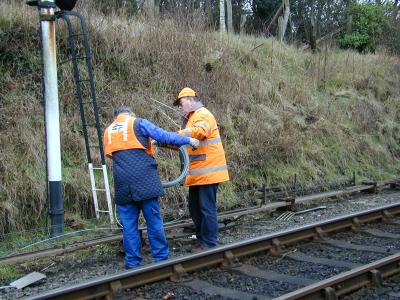
track circuit interrupter. Also the signal wire to no. 14 signal was found to be frayed
and was renewed - some pictures are included below.
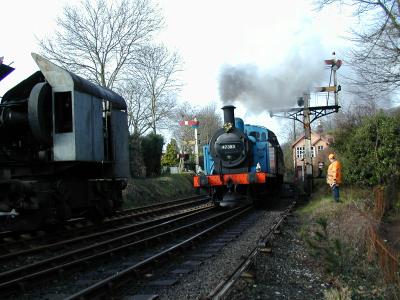
A brief pause on 10th February to watch the trains go by.
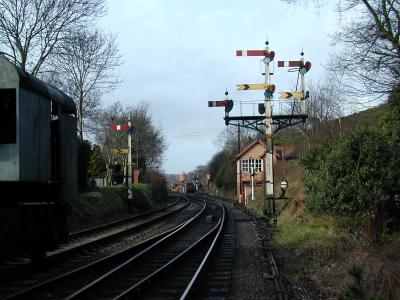
A pleasant view while we get trained on mechanical maintenance on 10th February 2002.
Wrestling with a coil of signal wire, Messers. Carr and Groves.
Arley
The Down Distant arm repeater and the 'power supply healthy' indication circuits share
a single tone generator circuit (this means that a fleeting 'power supply failure' alarm
is often given as the signal lamps are turned on or as the distant arm motors off).
Such reported faults are therefore routinely ignored by us but this became a solid
fault on 14 September when the power supply continuously showed 'Standby in use'
whilst the signals lamps were on. The fault was traced to one channel of the tone
generator and was repaired by the Department's expert in this field, Dave Stowell,
on 18 November.
Hampton Loade area
The signalling and telecomms. circuits between Highley and Bridgnorth share a single cable
which was progressively installed in the 1970s and 1980s as the overhead lines were replaced by cable and
there have been some signs of difficulties with the
omnibus circuit north of Hampton Loade and the tie line which connects stations south of
Highley (via Bewdley) with those north of Arley (via Bridgnorth). In between more major
disruptions caused by a landslip near Knowlesands Tunnel (November 2000), a cable failure
in Alveley Woods caused by a culvert collapse (April 2001) and contractors drilling through
the cable at Oldbury viaduct (July 2001), the Department has been trying to pin down the location
of these faults. There have been intermittent failures to release the Down Starter at Highley
on long section (thought possibly to be dampness at the beginning of the day) and on 27 October
an intermittent problem with the indication of the Up Distant at Hampton Loade was reported.
These faults naturally disappear when S&T personnel attend. On 29 December the indication
of the Up Distant was in order but the lamp repeater had failed at 'Lamp In' and therefore had
to be disconnected. A replacement lamp proving unit did not help and the indication fault was
finally traced to a cable fault between the Up Distant and the signalbox. The arm indication
might have been affected by the inhabitants of a distribution box on the Distant signal post and
having variously evicted mice and wasps, a design modification to remove the box and rewire
up the signal post is being prepared.
Examination by a pulse tester on Sunday 6 January forced the cable to give up some more
of its secrets as faults were identified within 40 yards of the Up Home, where the
cable runs up and along the bank - at the exact spots where large bonfires were being tended.
Examination showed that this could be the tie-line fault. Further examination found a location
cupboard near Sterns which had been made into a comfortable home for a family of shrews
who left as the door was opened. The Krone strips (contact blocks) had been almost eaten away
and this was thought to be the cause of the omnibus fault (but wasn't). A repair was effected by
Steve Bradbury, Paul Marshall, Adrian Hassell, Ralph and Neville Southwell on 6 January. The
equipment was left in working order that day (apart from the lamp repeater and the omnibus to
Bridgnorth) although the fires were still being stoked up. After the first light engine had
passed through the section on Saturday 12 January, it was found that the long section token circuits had
failed. In view of the number of faults on this section of cable, the CS&TE decided that
long section pilotman working between Highley and Bridgnorth would have to continue until the cable
could be repaired because of the potential risk of wrong side failures. A repair team was put
together for 19 January.
Before 19 January the exact location of the fault was investigated by digging down to the
cable and excavating a pit so that the wire armouring could be stripped back and
the offending cores teased out and cut for testing. Fortunately an enthusiastic application
of Rule 221(j) meant that the embankment had been cleared and the vegetation burnt, otherwise
digging pits to unearth the cable would have been much more difficult. Pits were dug 20, 30 and 40 yards from the
Up Homes and the fault was narrowed down to the 20 yard section adjacent to the Up Home. A
suitable length of 5-quad (20 core) cable was brought to site on 13 January.
On 19 January a team of ten assembled at Hampton Loade (Steve Bradbury, Paul Marshall, Bob Lawson,
Neville Southwell, Jim Pole, Grahame Gardener, Tony Neath, Chris Hall, Richard Heap and John Smith)
to repair the fault. The two furthermost pits were excavated to allow epoxy resin joints to be made
and the whole of the length of cable to be replaced was dug out two feet deep and the damaged
section of cable was cut out for jointing. Testing confirmed that the 110V power cable was
unaffected. A short section of the cable was stripped back to show the site of the fault where the cores
had fused together and was presented to the P. Way Department to add to their
collection.
The fault was where the cable ran up to the top of the bank and was fairly shallow at this point. The replacement cable has been laid somewhat deeper at about two feet deep. Comprehensive testing of the repaired cable showed all was in order
and Pilotman working was withdrawn and normal working resumed by late afternoon.
The new joint, before being filled with epoxy resin.
Eardington
A team of six (Gary Thornton, Derek Jones, John Smith, Tony Neath, Richard Heap and myself)
attended on 8 December to disconnect the ground frame and to reinstall it on some new
timbers donated by the Permanent Way department. We had planned a possession of the line after
the up empty stock had passed and therefore arrived at around 10a.m. equipped with the
Bridgnorth-Highley long section token to protect the work and to unlock the ground frame. A pleasant,
dry, but cold day saw the job
completed by around 4p.m. including digging out of the ballast, drilling holes for the coach bolts and
fang plates and refitting the ground frame. We took a portable generator, using a skate to get it to site
and the only unplanned journey was to fetch an angle grinder to deal with some obstinate and corroded nuts.
Hopefully this will now last another twenty years!
Faults and repairs
An analysis of the faults reported to the S&T fault line during 2001 has shown that of the 111 faults
reported, 13 were described as 'no fault found'; 18 were telecomms faults (and therefore not included in
this article); 23 were rectified the same week, mostly within a day or two, although another 37 took a
little longer than a week to repair, leaving 20 which are either low priority, unconfirmed or
require further investigation. Only three affected
safe operation - on 11 April a broken washer had caused a detection slide to become disconnected (investigated
and repaired within 2 days); on 19 May the FPL on 42 points at Kidderminster could not be engaged - investigation
showed that the equipment was operating correctly by preventing movements over pointwork where the
switch blades were not engaging correctly and this fault was referred to the PWay and repaired the same day;
on 2 December the Up Home signal at Bewdley North was not returning fully to Danger - this was repaired the same day.
Overall quite a good performance!
Planned work
Work planned for the immediate future is to rewire the Hampton Loade Up Distant, continue location maintenance
(eviction of spiders, cleaning with WD40 etc.) northwards from Arley, complete power supply testing
and commission two new signals at Bewdley North. This work will be fitted around the normal
routine testing programme as resources allow.