 S & T Notes - issue 128
 S & T Notes - issue 128
SIGNALLING NOTES - Chris. Hall
Accounts of the activities of the S&T department over the last five years have been notable by their absence. As the time goes by, the task of writing down what we have done becomes greater and greater. Since the last set of signalling notes in issue 105 (Winter '92/'93) our colleagues in the 'Telecommunications' section have appeared in print on two occasions in 1993 and articles on mole ploughing (issue 117) and some work mainly at Highley (issue 120) have also appeared. A plea for volunteers was made in issue 125: one or two new recruits have responded and are most welcome.Whilst the department may not have been engaged in visible major projects, which attract attention and comment, the ever present task of working behind the scenes to keep the signalling system safe and reliable continues. It is thus a compliment that our continued efforts are just taken for granted. The Severn Valley Railway possesses the largest signalling system of any preserved railway and this is kept working reliably and safely by a small number of volunteers. On our annual Sunday Luncheon event in July, naturally held in a restaurant car on the valley, the Department numbered some 23 (including some guests) and in the following 'S&T' week (split between signal box turns and maintenance work) a special train was arranged to facilitate cable laying at Bewdley South.
Five years is a long time but I shall attempt to include a mention of our activities over this period (up to the time of writing 3 October 1998). Perhaps the next set of notes will not prove to be such a challenge as it is the intention to make these notes a regular feature of the magazine. I shall start at the top of the line at Bridgnorth and work down.
Bridgnorth
Our northernmost outpost is the Boiler Shop Ground Frame (erstwhile Down Yard Ground Frame). The electric lock on this ground frame, released directly from the signal box, had reached the end of its useful life and was replaced in February 1997 by an Annett's key release obtained from a key release instrument installed in a newly constructed location cupboard replacing the previous installation (see photo above).
Slightly further south, renewals are pending at the north end of the station to remove an existing location cupboard from the onslaught of piles of boiler tubes and this work includes rebonding track circuit joints. Renewal of several locations (the S&T term for a cupboard containing cable terminations and the necessary local electrical equipment to provide track circuiting and other signalling functions) in more modern form has also been completed. There is a constant battle with vegetation surrounding locations and signals. The advanced starting and outer home signals and SPTs (signal post telephones) were well camouflaged by nettles and brambles. Earlier this year a deliberate act of vandalism occurred in which a number of signal wires were cut near the Cleobury Mortimer road bridge. Although no delay to the public service ensued this provided two members of the department with an unplanned day's work!
One example of recent fault finding was the signal repeater for the down inner home bracket signal (nos. 2, 3, 5, 6 and 10 signals). Although correct 'ON' (i.e. Danger) indication was shown, all but one of the signals would fail to show a correct 'OFF' indication. A quick check of the circuit diagram identified the likely culprit and after cleaning a set of contacts all was well again - all signals shewing a correct 'OFF' on the indicator without undue effort on the part of the signalman.
A more obscure fault, which presented as an occasional track circuit failure, took a little more investigation. After a fruitless search for problems on the track circuit itself, the problem was tracked down to a cable which had been caught and pulled out of position. This cable, the connection to the electrical detection of no. 12 points, had earthed onto the detector box mounted on the stock rail and thus caused the track circuit to show occupied.
Several rusty signal wire slings were found during routine lubrication of the signals and resulted in a request for two 8ft and one 10ft sling to be sent up in the brake van of the next train. For reasons which were (and are) unclear this was translated into two 96" and one 144" sling which duly arrived. After some head scratching this was somehow overcome without shortening and rejointing any signal wires.
The signal box batteries were renewed about a year ago to overcome a marked reluctance to provide sustained support for the signalling functions in the event of a power cut. This came in useful at the 1998 CAMRA beer festival weekend when power to the station was lost from about 1400 until 2215 when contractors working nearby (unconnected with S.V.R) managed to sever the supply cable. Supplies to one track circuit (11T) were the only casualty (as far as the Signal Engineering department was concerned) due to a failed track feed battery fuse. Unfortunately, although 'fail-safe', this forced all movements in and out of the station to be carried out by handsignalling until about 1530 by which time temporary 240V supplies had been arranged from another part of the site. Train services were maintained that day and evening courtesy of hastily arranged temporary platform (and bar!) lighting by the strenuous efforts of a handful of people on the scene. The only casualties were that, with only one platform open, the DMU was restricted to 3 cars and the passengers had to be detrained (in pouring rain) to allow a dining charter train to leave and the CAMRA beer tent had to be closed because portable generators did not arrive in time (and beer was running low anyway). The failed fuse in 11T track circuit was repaired the next day so the next power cut should see no disturbance to signalling functions.
Eardington
Worthy of mention just to say that routine testing of the facing point lock and maintenance of the ground frame connections has been carried out.
Hampton Loade
A minor alteration to the mechanical locking was carried out involving the manufacture of several gun-metal locks rivetted to steel locking bars and the cutting of vee notches in the vertical tappets driven by the levers in the signalbox. Routine maintenance and testing includes attention to location cupboards, signal motors, lubrication of moving parts, testing and adjusting facing point locks and detection. The terminal box at the up distant signal was opened up for routine maintenance and a huge nest occupied by a mouse was found. The usual eviction order was served but on the next visit the nest had been rebuilt and it was decided that the terminal box would be retained as a nesting box and the cable diverted.
Highley
Work at this signalbox was reported at length in issue 120 and there is thus little to mention. A small amount of careful precision work remains to be done to complete the mechanical sequential locking installation of which more in the next notes.
Arley
In 1996 a complete rewire of Arley signal box took place. This had to be done without affecting traffic on the line, and a week during which Arley was switched out was chosen for the change-over and commissioning. This took most of the week and the strenuous efforts of those members of the Department that could offer their services mid-week. Once a hacksaw was put through the existing wiring, the job was on! Installation of the new wiring runs was conducted in accordance with the new wiring plan and each end of every wire was labelled and checked by "belling out". Testing by personnel independent from design or installation activities took another day and the box was re-commissioned ready for the Saturday service. The new wiring accommodated the extension of electrical signal lamps throughout the site, home normal proving and distant interlinking.
After a battle through the undergrowth a new location cupboard has been installed at the top of the cutting adjacent to the down home signals and used to provide power for newly installed electrical signal lamps to displace the original paraffin lamps. Extension of electrical lighting to the remaining paraffin-lit signals at Arley, the only station where these remain, is in hand. Home normal proving has not yet been commissioned as it was installed in the expectation that mechanical sequential locking would be introduced, but this is not on the current work programme! Interlinking of the up distant has been introduced, which inhibits removal of an Arley/Highley token unless the up distant arm is at the "ON" position.
This installation gave no trouble (provided of course the distant signal was restored to the 'ON' position before releasing a token) until earlier this year. Between the up distant and the up home signals the electrical circuits are carried on a pole route - one of the two remaining routes used for signalling circuits, the other one being at Bridgnorth. A wire twist on the pole route introduced a phase-related fault which prevented the interlinking relay from operating correctly and inhibited the removal of a token from the Arley machine despite the signal arm shewing a correct 'ON' indication. Extensive investigation was required to identify and correct the fault and a brief spell of pilotman working was required.
The disc signal on the up main at no. 14 points (the facing connection into the sidings) was four sleepers north of the end of the fouling bar of the facing point lock. It had to be moved to close the gap. Although this sounds simple, the signal is attached to large concrete blocks buried in the ballast so it took four people a whole day to dig it up and bury it again.
Other work at Arley included renewal of a signal arm (no. 2 signal) and replacement of some of the moving parts of the facing point lock on the yard points to a more conventional arrangement. Major work, including scaffolding, to renew platform timbers on the down home bracket signal was described in issue 120.
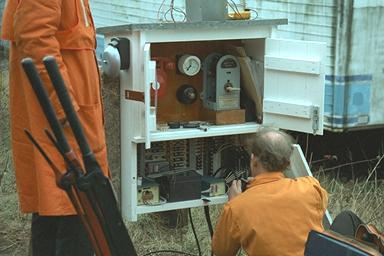
Installation of the Bridgnorth Boiler Shop Ground Frame location cupboard being carried out by David Wittamore under the eagle eye of John Phillips
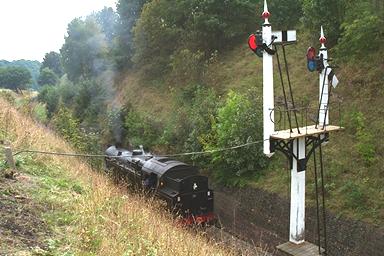
Arley down home signls - the platform timbers have been renewed and installation of electrical signal lighting is under way. The difficult bit is done - it just needs connecting up!