 S & T Notes - issue 129
 S & T Notes - issue 129
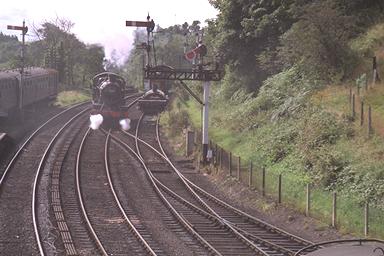
A familiar scene at Bridgnorth with the focus on the signalling rather than the locomotive.
SIGNALLING NOTES - Chris. Hall
A reminder first that the S&T (Signal and Telecommunications, erstwhile Signal and Telegraph) Department is responsible for the installation and maintenance of signalling and telephone equipment, and is not connected with the Operating Department which provide signalmen (although most members of the S&T are also signalmen). The article in the last issue suffered from the editor's blue pencil so the first half of this article completes the marathon task of writing up our activities of the last five years (episode two - the south end of the line). The article concludes with a look at the mixture of work that the department handles which comprises routine maintenance, planned renewals and attention to reported defects.Northwood Crossing
A location that gets little mention, this is the site of a private road crossing controlled by steady amber and flashing red road lamps - in the jargon this is called an AOCL. The treadles have been refurbished and the normal track circuit testing completed. The clock has been adjusted on several occasions to ensure that the warble sounder is quietened at night. However, the installation is due for refurbishment including repainting of road signal backing boards, fencing and removal of tree branches to improve the visibility of the road signals.
Bewdley North
The up home banner repeater was removed and completely refurbished last year and the power supplies strengthened. This has hopefully been appreciated by the locomotive department. The next step will be to get the up distant working: the distant signal and signal motor as well as wiring at site has all been installed but cannot be commissioned until the planned rewiring of this signalbox later this century. Mechanical locking modifications will be carried out as part of this work including making provision for a calling-on signal below the down main home to permit attaching movements to be carried out under the control of fixed signals.
At the north end of the station a virtually single-handed effort by one member of the S&T department has made an enormous difference. The up main to branch starting, back road home and inner home, and down main inner home signals (nos. 29, 35, 30 and 31&36 signals) have been given a complete repaint and refurbished arms fitted. A new aluminium symmetrically balanced arm has been fitted to no. 29 signal and its banner repeater on the footbridge has been completely refurbished.
Other work included the fitting of a track circuit interrupter on the trap point at the north end of the rock siding. This had not been considered necessary whilst the siding contained wagons in various stages of disintegration and restoration and saw few movements. Routine maintenance of facing point locks, detection, track circuits, lubrication of moving parts, cleaning of electric locks and contacts on the lever frame is another necessary and time consuming task that deserves mention.
Bewdley South
Renewal of the supporting steelwork and platform timbers on the down main inner home bracket signal was carried out without the need for scaffolding although this type of work may need such provision in the future. The location cupboard was renewed at the up main homes and this work was used as part of an examination for the issue of an IRSE testing licence for a member of the S&T Dept. Fault finding was carried out on the back road block instruments which had been reported as occasionally failing to hold the 'line clear' indication once the home signal had been cleared. This identified the holding coil circuit as the possible culprit: once the electric lock on the home signal lock is operated the circuitry prevents a 'line clear' being given (for which the home signal must be at danger) but allows a holding circuit to maintain the block at 'line clear'. All contacts, wiring and links were found in good order and were cleaned and connections retightened but no obvious fault was found.
A worn out compensator on the rodding-run to no. 12 points was replaced and some attention was given to mechanical detection which had suffered the ravages of time and seen some heavy usage. The Romesse fire in the signalbox was repaired almost in time for the cold weather. Foliage has been cut back by the permanent way department so that drivers' vision of the down signals in the vicinity of the signalbox has been much improved.
At the Kidderminster end of Bewdley tunnel several lengths of track were removed and the ballast dug out by the permanent way department. A good working relationship between the two departments ensured that there was no damage to the buried signalling and telecomms. cables and on completion the track circuit bonds were replaced and the track circuit retested.
Kidderminster
The mechanical signalling installation, which was installed and commissioned in two phases around 1984 and 1990, has settled down well. The use of the frame has increased relentlessly since the box opened and a count of the lever movements on a busy day on a Thomas weekend revealed over a thousand lever movements. A start has been made on the permanent platform one starting signal to replace the present route-indicating signal and disc which were installed as a temporary measure in 1987. The replacement signal will be a bracket signal with three arms. Meanwhile a replacement arm has been fitted to the temporary signal.
The revised lottery bid includes provision for an additional arch on the footbridge to provide emergency vehicle access and also allow access to the turntable which will bring into use spare levers in the signalbox which were originally provided for a similar purpose.
A repetitive but intermittent failure on no. 47 points - the no. 2 platform to engine line points worked by a point machine - causing the 'B' end of the points to fail to drive from reverse to normal has been investigated more than once. Contacts have been cleaned and retensioned within the circuit-controller inside the point machine to no avail. This fault exercised the ingenuity of the S&T department but was eventually traced to one of the contactors in the location cupboard. The contactor was changed and no further problems reported.
Maintenance
The execution of routine maintenance has been much improved by a "maintenance schedule" which identifies all of the routine maintenance tasks at each location and spreads the work evenly through the year. It means that tasks don't get wastefully repeated and it can be seen at a glance where effort should be directed. It has been in place since the beginning of 1998, and has had a noticeable and welcome effect on the number of reported faults. A comprehensive relay servicing programme has been established and the servicing of the many hundreds of safety critical relays is now controlled by this programme. During a possession of the single line between Bewdley South and Kidderminster in November, the line was closed which allowed the removal of plug-in relays for servicing by contractors. The relays were serviced and returned and all was in order by the Friday afternoon (6th November) for the weekend service to operate. The signalling infrastructure on the Severn Valley Railway is an extensive one and is kept working reliably by an S&T department staffed entirely with volunteers. In B.R. days such an installation would normally have required the full time attention of a permanent three-man team. Most (nearly all) signals are now electrically lit which compares well with out neighbour Railtrack where such modern delights in the Worcester area are still to come.
We have been successful in attracting two new recruits to the S&T through the Peter Edkins route for new volunteers (Steve Bach and Ray Atkinson), who are now helping significantly with the routine maintenance and one further recruit (Gary Townley) who is already an established volunteer. Somehow these new recruits have so far escaped the customary initiation of scraping signal lamps back to the bare metal.
Planned renewals
On 5 November the location cupboard on the up side at Bewdley South between the barrow crossing and the signal box was renewed. This location is connected to track circuits 21T and 22T and through circuits and a lot of preparatory work was carried out behind the scenes prewiring the new cupboard, fishing out concrete posts from Kidderminster yard amongst the buddleia bushes and arranging a special train during S&T week (in July 1998) to deliver the equipment and run out new cabling.
On completion of track relaying at the north end of Bewdley tunnel in early November, the track circuit joints were ready for rebonding by S&T. The working party was carefully issued with exactly the correct number of new track circuit bond wires by the CS&TE and was transported to site courtesy of the P.Way ballast train. The job proceeded without any hitches with grateful acknowledgment to the P.Way for the loan of their portable fluorescent lamps. On discovery of two broken bonds in adjacent sections the CS&TE was requested to deliver two further bonds to site - this time he arrived with some spares.
The crossover at the north end of Bridgnorth (no. 29 crossover) was retimbered by the P.Way at the end of November. We took the opportunity during the work to relocate a pair of insulated joints to correct the track circuit polarities and the reliability should also be improved. Renewal of the adjacent location cupboard is planned shortly - some track circuit bonds will be replaced at this time and the track circuit through the crossover will be drop-shunted over its whole length. Meanwhile the track circuit bonds were renewed and the detection was readjusted by S&T on completion. Getting the operation of a double ended crossover worked by one lever correctly adjusted is not always possible first time and this can be seen from the defect log below once the normal train service resumed on Boxing Day.
Some lengths of point rodding at Kidderminster have shown rust spots and some rodding in good condition was recovered from Pontypridd Junction and Porth in November during an engineering possession to replace the manual boxes by an extension to Radyr Junction panel. This will be used for spot replacements in the coming year. A special train is planned in the near future to recover redundant location cupboards displaced by the renewals programme and to facilitate the maintenance of signals without access ladders.
A new signal was brought into use on 24 January 1999 sited at the south end of platform 1 at Bewdley - it is an example, unique in preservation, of a Great Western backing signal with route indicator. The route indicator shows two routes - backing up the down main (shown by 'Dn Mn') and a movement into the sidings ('Dn Sdg'). Original plans to provide selection via the mechanical detection to discriminate between movements into the no. 1 siding or loop and the no. 2 siding goods shed road have been shelved for the moment. Mechanical work has been going on behind the scenes for some time and the results of the hard work by small number of people can now be seen. The new signal replaces the previous double disc signal situated in the 'six foot' and the changeover itself was carried out by a team of six attending to the mechanical side and two attending to the electrical side.
The first step was to make some modifications to the location cupboard by the Goods Shed to rearrange the signal lamp supplies so that it could be lit (the route indicator is illuminated by an 110V supply) and this was carried out on the Saturday. First job on the Sunday was to attach the signal arm to the spectacle casing of the new signal (so that it would exhibit a proper 'Danger' indication) allowing the metal faces and lamps on the double disc signal to be removed. The adjacent double wheel had to be moved to allow the new signal wire runs to clear the sleepers. This meant that a large concrete had to be dug up and reburied - a possession of the up main was taken for this work. Next the detection on 24A points adjacent to the signal had to be removed and turned through 180° so that the slides could move in the opposite direction. Meanwhile the heavy gang had ground off the fixing bolts of the base plate on the old signal and removed it.
The signal wire run for the down main home signal (no. 37) was diverted leaving many signal wires to be cut to the right length and adjusted. During the testing the yard points (no. 24) were disconnected because stock was standing on them in the yard. With everything complete, the lever leads in the box were changed to show the new names for no.20 (Down Main Backing) and no.23 (Down Main to Down Sidings Backing). Written notices had already been issued to operating staff giving information about the change.
In Great Western days a special addition to the Rules was made for Backing signals to the effect that:
"When a Backing Signal is lowered, the Engineman, if he has also received a verbal or hand Signal to do so, must back his Engine or Train past it, but he must regard the lowering of the arm only as an indication that the points over which he may have to pass are in the proper position, and that the Signals for Trains approaching in the right direction along the same road are at danger. The Engineman must not expect that the line will be clear as far as he may require to run, and he will be held responsible for stopping his engine short of any obstruction, or upon the exhibition of a danger hand Signal by the shunter, who, whenever necessary, must accompany the Engine or Train."
Reported defects
An extract from the S&T defect log covering December 1998 (excluding Telecomms. items) is reproduced on the next page to give an idea of the sort of defects that get reported to us. Each signal box had reported minor problems in this period and I have included some further explanation below.
Firstly at Highley the electrical release on the section signals was reported to be available after the signal had been cleared. This release should be 'one pull' but on attendance of S&T the following day the fault had cleared and could not be repeated. This will be monitored and further action taken if it recurs. The north end of 29 crossover at Bridgnorth saw major work by the P.Way (as referred to above) so the need to adjust detection had been anticipated. Further difficulties were subsequently reported with the operation of the crossover, difficulty in getting 29A (the end nearer the box) to close up when normal and thus preventing signal 18 being cleared for a move into the carriage siding. This will receive further attention in due course now that the service has resumed and the newly fettled crossover has had a chance to bed down.
At the end of the service on 19 December a light engine could not be despatched from Kidderminster to Bridgnorth because the section signal could not be cleared. Examination of the relevant relays showed the problem was at the signal. All track circuits were clear, the Acceptance Levers were correctly operating as was the lever for the section signal, so the Driver was given a ticket to pass the signal at danger (these are timed and dated and used for one occasion only) and this provided a handy lift to attend the fault. The motor cut out contact had not made up when the signal was last replaced to danger so this was exercised and cleaned and testing showed that the fault had cleared. The standby generator fault at Bewdley South had disappeared when the S&T attended and may have cleared as part of the self test of the equipment. The token failure at Bewdley North (where the Arley signalman could not obtain bell communication after inserting the token) could be a poor contact in the token machine which sometimes occurs in a damp signalbox at the start of the day. Pilotman working was instituted for the return working of the staff DMU but all was in order for the service trains. Occasional problems with detection are reported from time to time and, if they do not recur, are put into the category of 'faults that go home with the signalman'. No space for any more I'm afraid so I'll leave until next time a description of what detection is and why it is needed.
Extract from S&T fault log - December 1998
| Date | Defect | Action taken | |
| 6/12 | HY | Section signal electrical release faulty | Tested but fault had cleared |
| 9/12 | BH | Detection on 29B needs adjustment | Detection adjusted |
| 13/12 | BS | Standby generator indicator shows 'faulty' | No fault found |
| 19/12 | BH | 18/29A detection not made up | On the list |
| 19/12 | KR | 57 signal will not clear | Signal motor contact |
| 24/12 | BN | Token failure (09:45) | ) None |
| 24/12 | BN | Tokens in order (10:15) | ) |
| 27/12 | HL | Power shows standby when lamps lit | Known problem |
| 30/12 | AY | 24 signal detection not made up | None. No further reports |
| 31/12 | KR | 23/31B detection too tight (routine mtce.) | On the list |
| 31/12 | BH | 18/29A detection not made up | On the list |
| 31/12 | HL | Power shows standby when lamps lit | Known problem |
| 31/12 | KR | Slings on 15 & 58 showing corrosion | Monitor |