 S & T Notes - issue 131
 S & T Notes - issue 131
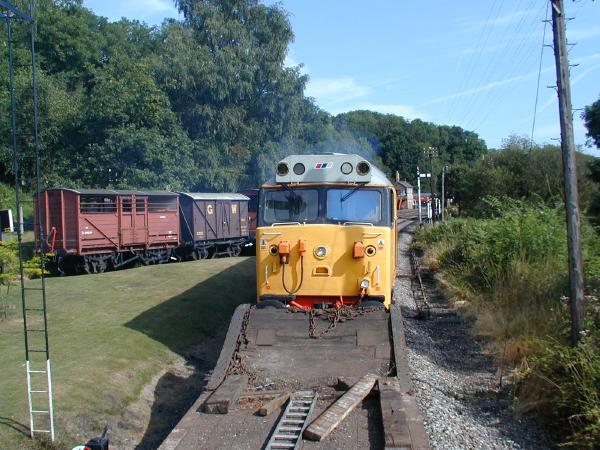 The Signal Engineer's train approaches Highley on Thursday 29th July 1999. Although the load is light - one ladder - it will be bringing back redundant location cupboards for recovery.
SIGNALLING NOTES - Chris. Hall
As the notes for the last issue closed for press (28th May) the mid-week running season was under way and another year had started. With the routine maintenance well up to date, thanks to the efforts of some new recruits to the Department, we have set our sights even wider. Not satisfied with the challenges available at �home‘ the Department took on a mechanical locking modification job at another railway. This has not passed unnoticed and the few defects that occurred in mid-June were, naturally, attributed to the brief absence of some members of the Department.The work that took us away from home was to carry out locking modifications to the mechanical lever frame on the West Somerset Railway at Williton, involving the introduction of five new levers. The new levers were to control a new ground frame, to provide for acceptance home signals and additional shunting signals. The design work had been done by the West Somerset Railway so our task was to remove the mechanical locking, mark the tappets for machining, modify the locks and bars to suit and reassemble. Before we could start, the mechanical and electrical locking on the frame was booked off and we were given possession. The frame would not be restored to use unless and until the completed work had been successfully tested by an independent signal engineer.
Mechanical Locking
The type of mechanical locking involved in the West Somerset work is GW 5-bar vertical tappet, the same type as that fitted at Kidderminster (originally Acton Yard) and Hampton Loade (originally Ledbury North End). Similar locking, GW 3-bar vertical tappet, is fitted at Arley (originally Kidderminster Station), Bewdley South and Bridgnorth (originally Windmill End Junction) and the original McKenzie and Holland frame at Highley has been converted to 5-bar vertical tappet using non-standard locking trays to accommodate the different lever spacing. The Great Western introduced 5-bar vertical tappet locking in 1923 and this rapidly displaced the then standard 3-bar type, which became obsolescent in the early 1940‘s. As in earlier GW tappet frames, a cam plate is attached to each working lever below floor level and slides horizontally with the lever, driving a tappet vertically so that the first movement of a lever from the normal position moves the tappet blade downwards. This initial movement locks all conflicting points and signals. The final movement of the lever completes the tappet travel and releases points and signals etc. for safe operation. The tappet movement is 2" in all. The vertical movement of the tappet, which is 1 15/16" x 3/8" in section, is guided by a locking tray which contains horizontal channels 3 1/8" apart. Two bars (11/16" x 1/4") pass beneath the tappet (bottom bars) and three bars (1/2" x 3/8") above (top bars) and are held in position by vertical straps. Gun metal nibs in the horizontal channels between the tappets move the locking bars and vice versa by means of 1/2" x 1/4" studs (or drivers) rivetted to the bars. On their working face or faces, the nibs are bevelled on both edges and effect the locking by means of Vee notches (ports) cut in the tappets in the normal and/or reverse position. Since July 1933 one nib on each bar had to be fixed to the bar (by rivets or screws) so that misalignment of the studs during assembly was prevented.
The work at Willition was similar in nature to work carried out by the Department recently at Highley and Hampton Loade and consisted of removing the locking bars, nibs and tappets, marking up new ports on the tappets and making up new bars. During the work a check signalman had been rostered to supervise the duty signalman, who was without the benefit of mechanical locking in the box.
If the ports are cut in the correct place on each tappet, if the drivers are rivetted onto the bars in the correct place and if all the nibs are inserted at the right place, it will all work perfectly. Just in case they might not be, the mechanical locking of the frame would be given a complete test on completion of any work that disarranged the locking to prove that all levers were correctly locked.
I may have digressed a bit by speaking about another railway but all of what I have said about mechanical locking could just as easily have been said about most of our signal boxes.
Projects �in hand‘
Rather than speak at length about our routine maintenance, which continues to form the majority of our work (it is difficult to find something new to say about this) there are a number of projects which the Department is tackling which deserve mention. Tackling the CS&TE in an off-guard moment revealed that there are four main areas of work for the Department in the months ahead. These four areas are the installation and commissioning of a new location cupboard near the Boiler Shop at Bridgnorth, the rewiring of Bewdley North box (which will be associated with some minor design changes and bringing into use the up and down distants), a depot protection scheme for the new Carriage Shed at Kidderminster and the possible introduction of fully functioning A.W.S. (B.R. standard not, unfortunately, Great Western) to assist with the testing of modern traction units.
We are also planning the manufacture and installation of a new 5 doll bracket signal to control departures from platforms 1 and 2 at Kidderminster, replacing the existing signals. This cannot be fitted until the crossover giving access to No.2 engine line is redesigned to provide less sharp curves on the loop to platform 2 running line and to increase the capacity of platform 2, bringing the fouling point of platform 2 into line with that of platform 1, nor can it be fitted unless and until the footbridge extension has been built and the barrow crossing removed. The signal will be built to accommodate a later platform extension. Replacing disc signals 26 and 34 by short arm signals would require electric locks to be fitted to these levers to add electrical detection to the releasing conditions.
Discussions are taking place on the depot protection scheme for the new Carriage Shed which would introduce controls on the clearing of any signal reading into the yard. At present a shunter‘s release is provided by means of a plunger which should not be operated until the route is set correctly in the yard. This plunger electrically releases the lever in the signalbox controlling the yard points. It would be normal to provide more protection than this in a depot, including a signal under the control of the depot controlling the entrance of trains. This could be done by means of a ground frame operating a yard entrance signal or electrically releasing signals 26, 34, 38 and 43 in the signalbox for movements into the yard.
Sighting boards have been fitted to the Up Home Signals at Kidderminster (2 and 5) and to the Down Outer Advanced Starting Signal at Kidderminster (no. 57) and are to be fitted to the Down Home Signal at Bewdley South (no. 1) and the existing sighting board on the Down Home Signal at Bridgnorth (no. 1) renewed.
The new location cupboard for Bridgnorth is nearing completion as I write these notes (October 1999) and a survey of the cable run to the new cupboard in its new position against the Boiler Shop has been made and cable troughing ordered. Installation of this cupboard (originally planned to take place during S&T week this year) is now scheduled for the end of 1999 before starting work on Bewdley North and will complete the current programme of location cupboard renewals.
There are quite a few projects that are not yet �off the ground‘, some of which are definite intentions and some of which are only at the ideas stage.
Bewdley North signal box needs to be rewired in the next few years and some minor design changes will be included in this project. Amongst these is to bring into use a calling on signal below the Down Main Home and to bring into use the up and down distant signals. An additional Bewdley South Up Main Outer Distant may be fitted below Bewdley North Up Home Signal and banner repeater, the wiring for which is already provided. Also a signalled move may be provided from the Up Inner Homes bracket signal into the rock siding now that this siding sees a lot more use (from the north end) for stabling of the DMU. Preparatory work is likely to start this year once the Bridgnorth boiler shop location renewal has been completed. The work in earnest would then start in early 2000.
A connection from no. 2 engine line at Kidderminster to the turntable under the new footbridge extension is also being considered. This would involve mechanical locking modifications (of the type described above recently practised by the Department at Williton) and the provision of a new track circuit.
The Department has considered the feasibility of installation of fully functioning A.W.S. in order to assist with the testing of modern traction units. This would have to be B.R. standard A.W.S. as the Great Western system has effectively disappeared. Other projects that the Department might need to resource, but which remain on the 'back burner', include completion of the electrical signal lamp installation at Arley (so far only partially complete), a disc signal at Highley for movements into the yard from the north end, commissioning of full interlinking between Arley and Highley and installation of sequential locking at Arley. A new wooden doll may need to be fitted to the Arley Down Main Home.
S&T week
The Department's annual working week, S&T week, took place in the last week of July and commenced with a Sunday lunch on the Venturer, the volunteer-run restaurant car. Some twenty members and family came along and a good time was had by all. One member had spent the early morning attending to a track circuit failure near Bewdley tunnel but two members were rash enough to prefer a day on the footplate firing. Needless to say beer glasses were waved at them at every opportunity as we passed during the day, the normal salute being given in reply. Those of the Department who are also signalmen had first call on signalbox turns on the Monday and Tuesday but there was an S&T presence on the railway all week, Denvir Drury and Steve Curtis on the Monday and Tuesday, joined by John Phillips, Adrian Hassell and Chris Hall for the rest of the week.
The bolt on 31 points at Kidderminster was repaired and adjusted on the Monday. On the Monday and Tuesday efforts were focused on Northwood Crossing: one road lamp post was leaning and had to be dug out, straightened and repacked. The road lamp backing boards and crossing sign were washed, the batteries topped up, taking 2 gallons of water, and the track circuit cables were renewed. On completion of the work at Northwood, a down train was hailed at the Halt and a fruitless effort was made to load the extending ladder into the luggage compartment, to be dropped off at Highley. A few trains later, a luggage compartment was found into which the ladder would fit! Highley Down Distant Signal lamp cable had a junction box half way up the signal post and the jointed cable from the location cupboard to the signal lamp was to be replaced with a single length of 2-core 50/.025 cable. In the pub that evening it was agreed that while the work at Highley was completed, the rest of us would start work on tracing the signalling cables at Bewdley North between the Up Inner Homes and the Down Starting Signal.
Using a cable detector we confidently traced out the route of the cable from the Tenbury stop block towards the footpath crossing, confirming the position of the cable by digging a small hole. This worked well for the first hole so we pressed on, marking the route with a paint spray over the whole length. Our confidence got a bit dented when no cable could be found nearly two feet down at the second hole and a few holes later (also empty) we decided to halt for lunch. Bewdley buffet was able to provide sandwiches (but no pop) so we demanded tea from the signalman at Bewdley North. After more fruitless effort in the relentless sun and another break, inspiration came and we realised that we had been tracing reflections from the signal wires (and fence wires) and holding these back produced slightly better results. Not good enough to trace the cable though. Further inspiration and we connected a Telecomms bell across a spare pair of wires and connected the other end of the spare pair to a 110V supply. Success - lots of radiated energy and much easier to trace and mark. The position was confirmed by a few more holes (the crowbar causing only superficial damage to the cable) and measurements taken. One curious member of the public contacted Bewdley to mention that a bell was ringing and hadn't been answered!
By this time it was the end of the day so the task of moving the signal wire stakes for nos. 1 and 28 signals back from the Tenbury trackbed had to be left to another day and, in fact, this proved unnecessary as the track was laid successfully without the need to move the stakes. By the end of August the second rake of coaches, stabled at Bridgnorth during the table D running period, would be looking for a home and the siding on the Tenbury trackbed was relaid as far as the footpath crossing and a manually operated wheelstop has been provided to protect the running lines.
On the Thursday a special train had been arranged to facilitate maintenance of the ladderless signals �out in the sticks‘ and to recover redundant location cupboards and associated scrap cable, concretes, etc. from the location renewals programme. The timings of this train were as follows:
| Kidderminster....dep | 9. 5 | Bridgnorth........dep | 12.55 |
| Bewdley................. | 9/15 | Hampton Loade.... | 1/10 |
| Highley................arr | 9.34 | Highley..............arr | 1.20 |
| ......dep | 9x36 | .......dep | 1x43 |
| [stop] | Bewdley.............arr | 2. 1 | |
| Bridgnorth............arr | 10..50 | .......dep | 2.40 |
| [stop] | |||
| Kidderminster...arr | 3.30 |
The first priority on the down trip was to stop in section at three places between Highley and Bridgnorth, before the first passenger train. The Hampton Loade Down Distant (motor operated) received the normal routine oiling and greasing of the signal machine, oiling of the moving parts of the arm, cleaning of the signal arm, lamp and spectacles and cleaning and adjusting of the arm repeater contacts. The Up Distant (mechanically worked) received similar attention including a close look at the repeater contacts. The cabling from the adjacent location cupboard to the signal is jointed in a junction box on the signal post and was to be renewed as a single cable. The replacement cable was measured as 20 feet plus 3 paces. The junction box contained a bird and bird‘s nest and as the deceased occupant had no further interest in the nest it was evicted. The last stop was at Eardington Ground Frame, which is released by the long section token. The ground frame was oiled and the facing point lock tested. Arrival at Bridgnorth was at 10.55 where the train was run round and shunted into the yard.
After lunch we loaded some redundant location cupboards from the boiler shop ground frame area (which we had to carry as the Hollybush Road Siding was full of stock) and set off at 12.55 (as soon as the down train had arrived) and after a brief stop at Hampton Loade Down Distant to complete the maintenance, arrived at Highley to cross the down passenger. Next port of call was Bewdley where some redundant location cupboards were to be loaded and then four signals were to be maintained in the section to Kidderminster. By now there was some competition for paths on the single line but we had a booked slot and the P.Way and a driving school had to wait. We knew that the lamp on Bewdley South Down Home (no. 1) signal had failed but were unable to trace the fault in the time available. The remainder of the maintenance was completed, noting that the signal arm contact box drive was loose - this will be replaced in the near future when the signal arm and spindle are renewed. The following weekend four separate faults were found, and repaired, on the signal lamp.
We pressed on to the Bewdley South Down Distant (motor operated) where the yellow aspect was seen to need replacement. A brief stop at Kidderminster Up Distant to oil the moving parts and we had run out of time. The down passenger left and the up passenger arrived whilst the recovered location cupboards were unloaded and we propelled back out to the Down Outer Advanced Starting Signal (no. 57), following shortly behind the P. Way. As we were completing the maintenance of this signal, furious whistling from the driving school at the Up Homes could be heard. Taking a look around the CS&TE commented that the track ends (relay end of AC track circuit and feed end of AD track circuit) could do with replacement. We returned to Kidderminster and put the train away in the yard and released the class 50.
The first of the class 175 units (175.101) arrived on a low loader whilst we were taking our lunch break and made an immaculate entry to the station in reverse with the rear wheels of the trailer being steered from a control box. The second unit (centre car) was delivered later that day and the third the next afternoon (with a less than immaculate arrival when a hydraulic hose burst while the unit was right across the main road outside the station!). The services of the S&T were called upon to help push the first unit to the end of the siding after delivery so that it could be dragged out of the way by the class 50 (which is provided with a swinging coupling). These units will be undergoing testing on the S.V.R. as well as between Birmingham and Marylebone and will be permitted to run on S.V.R. at up to 50 m.p.h. out of traffic hours. The first run took place on Thursday 26th August.
On the Friday the damaged track ends at Kidderminster 57 signal were replaced. Actually it was very hot work to dig out the existing cables, lay in four new single core cables, replace and solder the track connections, reterminate the new cables and relace the wiring loom and this took all day, with some work overflowing into the Saturday. All in all a very successful week although I am not sure whether the amount of work on our list actually shrank or not, as we found several more things that needed doing.
Other work completed by the Department up to the end of October included replacement of the F.P.L. stretcher and replacement and recutting of a detection slide on no. 12 points at Bridgnorth, replacement of a compensator on the rodding run to the F.P.L. (no. 11) and a check of the pins and compensators on this rodding run, following some difficulty in unbolting the points on a hot day. Some of the pins and a compensator will need to be changed. The detection and drive connections on 24B points at Kidderminster (yard exit trap points) were replaced and the detection recut.
We have vacancies for two painters to bring all the signals and location cupboards on the railway up to the high standard of finish which has now become the norm at the north end of Bewdley station, thanks to the considerable efforts of one member of the Department. This is a quite attractive job, working by the lineside on dry days only. and is becoming an urgent task so if anyone out there would like to undertake this much needed work, please contact the VLO, Peter Edkins.
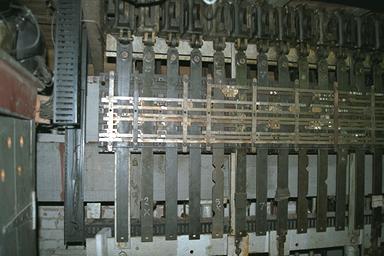
A close up view of some mechanical locking with top bars and straps removed. The ports, fixed locks and bottom bars can be seen as well as the studs driving the 'hollow' sliding gun-metal nibs.
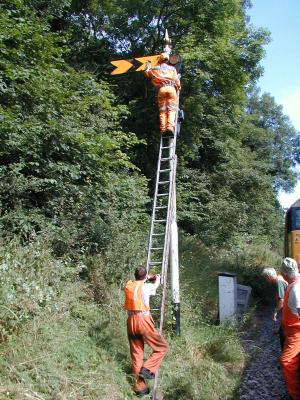
Cleaning and oiling Hampton Loade Down Distant