 S & T Notes - issue 132
 S & T Notes - issue 132
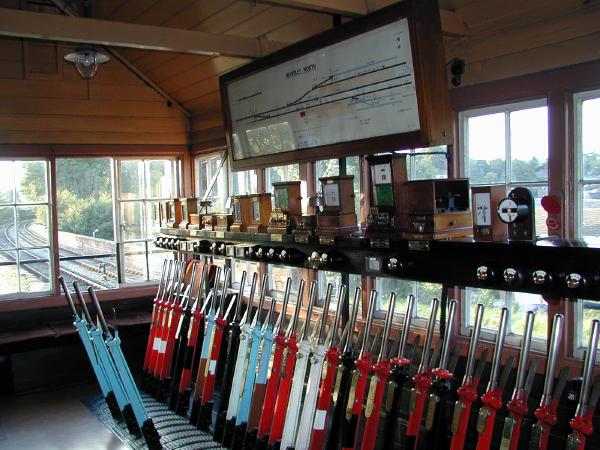
An interior view of Bewdley North box showing the block shelf, signalbox diagram and lever frame. The levers are coloured to show their function - the white levers are spares, the red levers operate signals, the black levers operate points and the blue levers operate facing point locks.
SIGNALLING NOTES - Chris. Hall
The last notes covered the period up to the end of October 1999 so these notes cover a fairly short period to meet the editor's deadline of the end of January. Out of the main running season, with the days being much shorter (and colder!), our activities are mainly confined to routine maintenance but quite some attention has been given to planning work at Bridgnorth (location renewal) and Bewdley (North box rewire). The year 2000 promises to be a busy and interesting one for this Department.Bewdley North
Further information on the work at Bewdley North is that the job will fall into several packages: preparatory work for new cabling; mechanical locking modifications involving a move �one pace left‘ for the Down Main Home Signal lever to release the right-most lever (no. 37) for use as a distant signal lever; the rewire itself over a few weeks sometime between June and September and, finally, completion of outside work to commission the new signals. The shuffling of levers has been done so as to avoid �pull betweens‘ (that is where a lever needs to be reversed when the levers on each side are already reverse) although, of course, all our signalmen are slim and fit enough to be able to cope with this on a 5¼" frame. Well nearly all.
Some replacement block instruments of a more modern design have been identified and, due to constraints of space below the box, it has been proposed that signalling relays be housed in a relocatable equipment building (REB) on the end of the platform. Manufacture of the calling on arm to be installed below the Down Main Home Signal has started and, as part of normal refurbishment work, replacement signal arms are being made for the Up Inner Homes bracket. A fuller account of the North Box work will have to wait until later this year when we've got our teeth into it.
Other work carried out by the Department (apart from routine maintenance) in this period includes manufacture of a replacement signal ladder for Hampton Loade Down Home signal, repainting of Bewdley South Up Back Road Home signal bracket, and a start has been made on refurbishment of Bewdley South Down Inner Home bracket. A start has also been made on the replacement of the Bridgnorth Boiler Shop location cupboard which is the last remaining location cupboard in the currrent renewals programme. Deterioration of the existing cupboard was greatly assisted when it was nearly demolished by the Iron Fairy (a mobile crane) and has taken on an extremely pronounced list and some equipment is almost resting on the ballast. This has now made its replacement an urgent requirement. Glass reinforced concrete (lightweight) troughing has been dug in at the site ready for the new cabling and the new location cupboard has been manufactured, with the exception of a small amount of woodworking. Its installation and commissioning will be covered in the next article.
Defect rectification
Reported defects are running at an all time low thanks to routine maintenance. However there has been some trouble with operation of no. 47 points at Kidderminster - the motor operated engine release crossover on platform 2. The gremlin has been chased away from the location adjacent to the crossover when we eventually traced the fault to a contactor and replaced it (see issue 129). It has reappeared in the circuit controller (the electrical locking and circuit controls beneath the frame) onto which oil had run making operation of the electric lock sluggish. Operation of the lever itself forces the lock into engagement between each check position and correct engagement of an electric lock is proved by circuitry before signal levers are released. The effect was therefore that the lever was sometimes locked when it should have been free. This meant that run round moves in platform 2 occasionally required use of the handwind mechanism. This problem was solved by stripping and cleaning of the circuit controller at the earliest opportunity out of traffic hours.
The following day the gremlin made its last appearance (perhaps!) and a further problem was reported that 47 lever was locked reverse preventing the points from being normalised. The gremlin had moved to the top of the lever and onto no. 50 signal wire causing the disc signal reading over the crossover not to go quite back to Danger when replaced. Although 47 lever was then mechanically free (levers controlling relevant signals were normal in the frame) the 'when operated' approach locking on no. 50 signal was correctly locking the point lever reverse. Since we knew the pre-existing fault causing the lock to fail to operate (which had been present intermittently over the previous few weeks) had been fixed the day before (and our faith in our work was of course unshakeable), we were able to clear this fault over the telephone by a quick reminder to the Signalman of the provisions of Rule 65.
Approach locking - what is it?
Now seems like a good time to describe one of the more complex items of locking that does not normally see the light of day. It could be said that any form of locking should never be experienced by the Signalman since he should only be attempting to operate levers that he knows to be free. All Signalmen have 'pulled against the locking' at times but the locking I am about to describe ('approach locking') does not become noticeable if the train movements take place in the intended sequence.
First of all the introduction of track circuiting has allowed a main running signal protecting a facing point to be sited quite some distance in rear of the point itself. Prior to the introduction of track circuits, a protecting signal would be placed close to the facing point or points that it protected with a fouling bar extending over the whole length from the signal to the point switches. Operation of the facing point lock(s) to lock or unlock the points would require the fouling bar(s) to be lifted, which would be prevented by the presence of the flanges of a wheel standing on the relevant piece of track. The wheels of a train which had proceeded past the signal, but not yet moved clear of the points, would therefore hold down the fouling bar causing the points to remain locked in position even if the signal itself was replaced to Danger.
The same function can be provided by means of track circuits where the presence of a train is registered electrically and the lever controlling the facing point lock is held in position electrically if any of the track circuits between the running signal and the points (including the track circuit on the point itself) show occupied. The separation between the running signal and the point is limited by the ability of the signalman to lift a fouling bar of the requisite length but in the case of track circuits this limit on distance is removed. Where several track circuits are provided over a long distance between the signal and the point then simply 'dead' locking the points by occupation of any of these track circuits may prove too restrictive (for example to permit a shunting movement).
In such cases the locking becomes more complex: route locking would be provided so that the occupation of any of the track circuits in advance of the main running signal, between the signal and the facing point, only initiate the locking at a time when the running signal may be displaying a 'proceed' aspect, thus making the locking directional. The point is then locked in position even if the signal were replaced to Danger behind the train and the train brought to a stand in advance of the signal (unless the train passed beyond the points). The route locking would then prevent movement of the points until the train had either continued its journey and passed beyond the points or been drawn back behind the running signal, hence the name 'route locking'.
Route locking is provided, for example, on the Up Home signals at Kidderminster, which are about 850 yards from the facing points they protect.
As described so far, this would not provide protection if the signal were replaced to Danger just ahead of an approaching train. Approach locking is invariably provided in these cases. Approach locking initiates the route locking whenever the signal is cleared and also maintains the route locking if the signal is replaced to Danger before the train has passed the signal.
Approach locking is often misunderstood: with the signal lever reversed the point lever(s) and facing point lock lever(s) for the route selected are mechanically locked. Once the signal lever is moved from the normal position or the arm repeater 'on' indication is interrupted then the approach locking is initiated. If the signal is replaced to Danger for any reason the approach locking is only released if (i) the train has not yet approached closely enough for the Driver to have sighted the signal in the clear position; (ii) if the signal could have been sighted by the Driver but sufficient time has elapsed (normally 2 minutes) for the train to have stopped safely in rear of the signal and the track circuits ahead of the signal have not been occupied; or (iii) the train has obeyed the signal, proceeded along the route and passed clear of the points. Normally the route locking is released by the normal passage of the train, as in (iii) above. Thus the route cannot be altered if there is a possibility that the train may be approaching the facing points but, while all movements are taking place in the intended sequence, the approach locking is effectively invisible to the signalman.
Where insufficient track circuits are provided on the approach to the signal to determine the position of an approaching train, then the approach locking is initiated as soon as the 'on' or 'Danger' indication of the signal arm is interrupted and is referred to as 'when operated'. Where suitable track circuits exist, comprehensive approach locking allows the locking to be released if the signal is replaced to Danger before the Driver of an approaching train could have sighted it in the clear position.
In mechanical signalling areas most trains under the control of the signalman are close to the signal box and train movements can be observed directly by the Signalman who makes his own decisions when it is safe to move a set of facing points. Approach locking is therefore unusual at a mechanical box. It is however always provided in multiple aspect signalled (MAS) areas where the signalbox is more remote.
Comprehensive approach locking is provided at Kidderminster on nos. 2, 5 and 13 signals. Approach locking is also provided at Kidderminster on no. 50 signal (when operated) and on no. 57 signal (comprehensive) and at Bewdley South on no. 30 signal (when operated). In each case a timer is provided - two minutes in the case of a running signal, four minutes for a movement onto a single line and 30 seconds for a shunt signal.
There are other circumstances where occupation of track circuits is only required to lock signals when occupied by movements in one direction and is required to leave them free when occupied by movements in the opposite direction. For example a train may be permitted to draw forward to follow another train but not if the other train was approaching.
Directional track circuit locking is provided at Bridgnorth (on nos. 15, 20, 21, 23 and 24 signals against down movements past no. 1 signal), at Bewdley North (on nos. 29, 30 and 31 signals against up movements past no. 1 signal) and at Bewdley South (on nos. 19, 24, 31 and 32 signals against down movements past no. 1 signal). This means for example that if a down train has arrived at the Down Inner Homes bracket signal at Bridgnorth it is not possible to signal an engine from the platform (using the calling on signal provided) to approach it, whereas if exactly the same track circuit indications have come about by shunting movements from the station area then it is possible to signal such a move.
Two pages describing approach locking is probably enough for the average reader and is commended as a cure for insomnia.
Vacancies still exist for a painter or painters to bring all the signals and location cupboards on the railway up to the high standard of finish we expect. This is a quite attractive job, working by the lineside on dry days only. so if anyone out there would like to undertake this much needed work, please contact the VLO, Peter Edkins.