 SVR S&T Dept.

SIGNALLING NOTES - Chris. Hall
SIGNALLING NOTES - Chris. HallNormally my prompt to write this article is the sound of the previous issue hitting the doormat but this time I forgot and got a nudge from the Editor! We have been busy over the non-running period, with no time to spare to finish the re-timbering at Arley, so the scaffold is still there. The principal jobs that required no trains running were to move a pair of compensators at Bridgnorth about six yards closer to the box, replacing the diagonal strut on the Up Inner Homes at Bewdley (which had suffered corrosion damage) and to replace the signalling cable between the Down Outer Advanced Starting Signal and the Up Homes at Kidderminster.
Arriving at Bridgnorth on 8th January to start work, our first task was to get the stock shunted out of our way - thanks to Adam Thomas (Shunter) and Adrian Hassell (08 Driver) we put five coaches behind the Western Diesel on the Carriage Siding and the other four out of the way at the north end of Platform 2. We had turned out in force, with John Smith, James Marrion, Martin Wood, Tony Neath, Adrian and myself and managed to dig up the old concretes and plate, dig the new holes using wooden replicas of the concrete blocks to get the holes level and at the correct depth (much easier to lift in and out than the real thing) and had the concretes in place, levelled, by the end of the day.
 The second weekend at Bridgnorth and the concretes have been levelled in their new location, the only trace of their previous position (six metres further south) is between the roller blocks where we have yet to replace the rodding [Photo: J. Smith]
The yard points (no. 14) and the Down Main to No. 2 Platform Line Facing/No. 1 Platform Line points (no. 12) and their facing point locks (FPLs) (and associated signals) were left disconnected until completion. By the second Sunday we had taken the opportunity to replace a worn compensator on 14 points and to reconnect the yard points and FPL. Rodding for 11 and 12 was cut to the correct length, adjusted and tested on 22nd January, finishing at lunchtime. At Bewdley we made up a new insulated FPL stretcher for 12 points at North box, matching the length of the existing stretcher - the scaffold for the Up Inner Homes was not yet erected.
 The Up Inner Homes, jacked up so that the diagonal strut can be replaced (27 January). [Photo: J. Smith]
The next two weekends were spent replacing the corroded diagonal strut on the Up Inner Homes (if you look closely at the photograph you can see the corrosion hole right through the diagonal strut just above the lower support), and fitting a second stay wire to the main post - to be buried later - giving us just time on 5th February to mark up the new stretcher and to machine two slots for the FPL. The last Sunday (12th February) was spent on trial fitting of the new stretcher, final machining, adjusting and testing.
 A close-up view of the strut that we replaced. [Photo: J. Smith]
While we had been busy at Bridgnorth and Bewdley, the rest of the Department were busy removing degraded cable ends at Bewdley South and doing the necessary preparatory work for cable replacement at Kidderminster. The principal reason for the cable replacement was explained in the previous issue (degradation after its disturbance during the work on the Worcester Road bridge some years back) and there were no spare cores remaining. This necessary replacement gave the opportunity to install extra capacity to cope with possible developments at Foley Park.
On Monday 23rd January, John Phillips, Rob Davis, Ben Humphries and Dave Stowell, assisted by Trevor Davies driving the 08 dragged out the old cables over a distance of about 440 yards. There were some particularly difficult lengths behind the houses between Hoo Road and Worcester Road bridges where about 30 years of debris (including builders’ rubble) had built up over the route of the cables! Rob and Ben then spent much of the rest of the week tidying up and disposing of the lengths of recovered cable.
On Sunday 29th January John Phillips, Thomas Franklin and Dave Stowell laid out the three replacement cables (one each signalling, power and telecommunications) from drums using an 08-hauled engineering train (Driver: Don Shadwell). On Monday 30th (pictured) the hired trenching machine was delivered (an almost brand new mini digger made in Australia) and was used to bury the new cables (from the Up Homes to the Worcester Road bridge where the ballast shoulder allowed, otherwise the new cable was encased in flexible tubing).
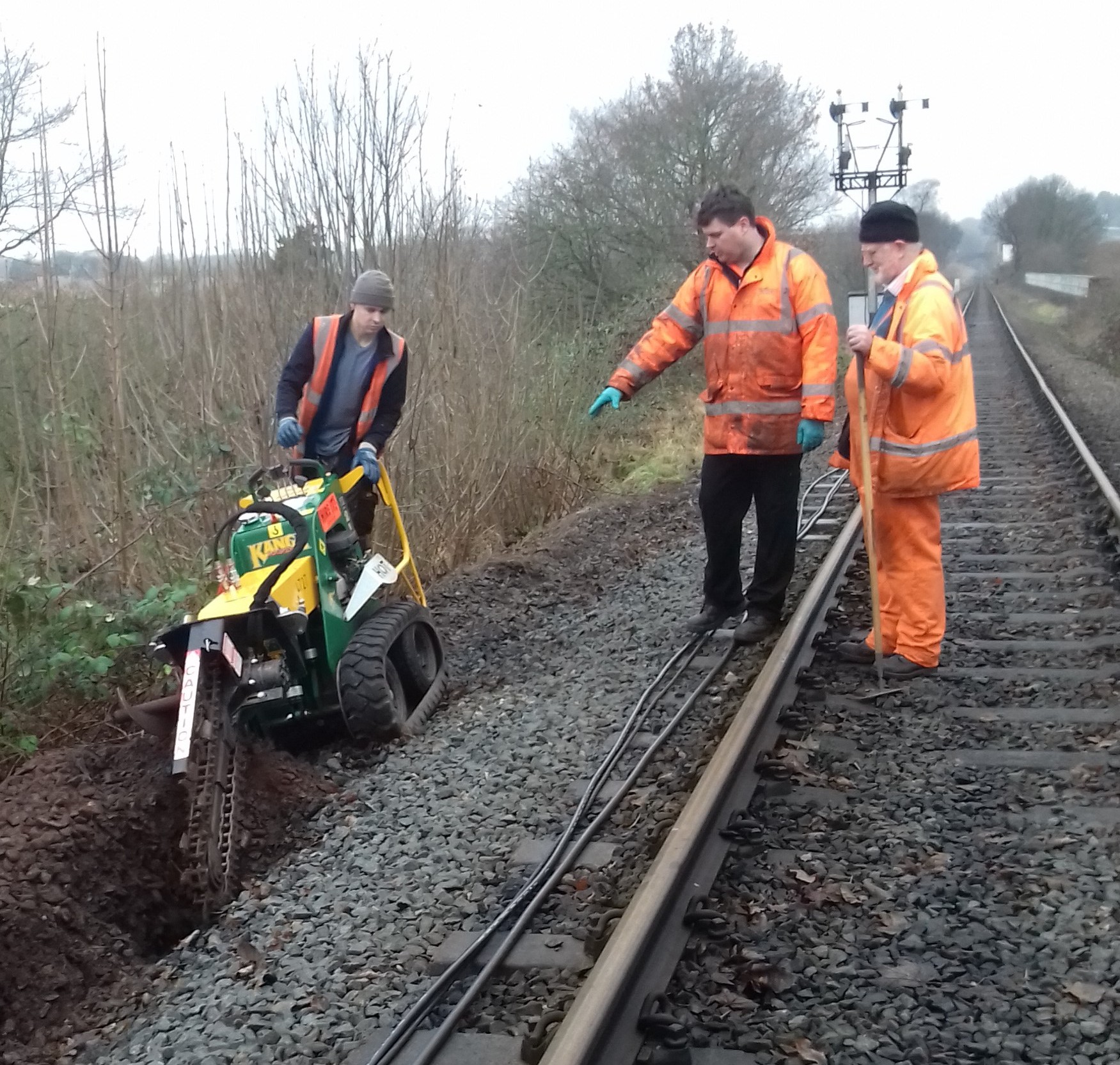 After some discussion, Ben wins the competition to drive the trenching machine. Rob and Dave look on unenviously. [Photo: J. Phillips]
Rob and Ben, assisted by Geoff Finch, then continued with the job over the next three days, at times in difficult and sometimes challengingly muddy conditions behind the houses. By the following Monday all the cable ends had been terminated (some 49 conductors), checked for continuity and insulation and all the circuits, both local and through to Bewdley South, had been thoroughly tested to ensure that it was all operating safely as before. There is still some tidying up to do to bring the 30 year old location cupboards up to our modern wiring standards but this can be done, without disruption, with the trains running.
Thanks to some of the young signalmen, the interior of Bewdley North boxhas been thoroughly redecorated, probably for the first time since the Severn Valley took over.
The last job (which we could not start until the P-Way had completed relaying at Waterworks) was to bypass the damaged section of signalling cable there with a temporary cable to allow token working. During the possession arrangements had been made to switch in Hampton Loade temporarily (so that the P-Way could run round there) but by Monday 13th the Loop there was clear and it was switched out again. Two of the signal arms on the Bewdley South From Kidderminster Down Inner Homes bracket were removed, refurbished and repainted by Martin Crane. I think that covers all of our efforts between Christmas and February Half-Term week and, indeed, mentions nearly everyone in the Department.
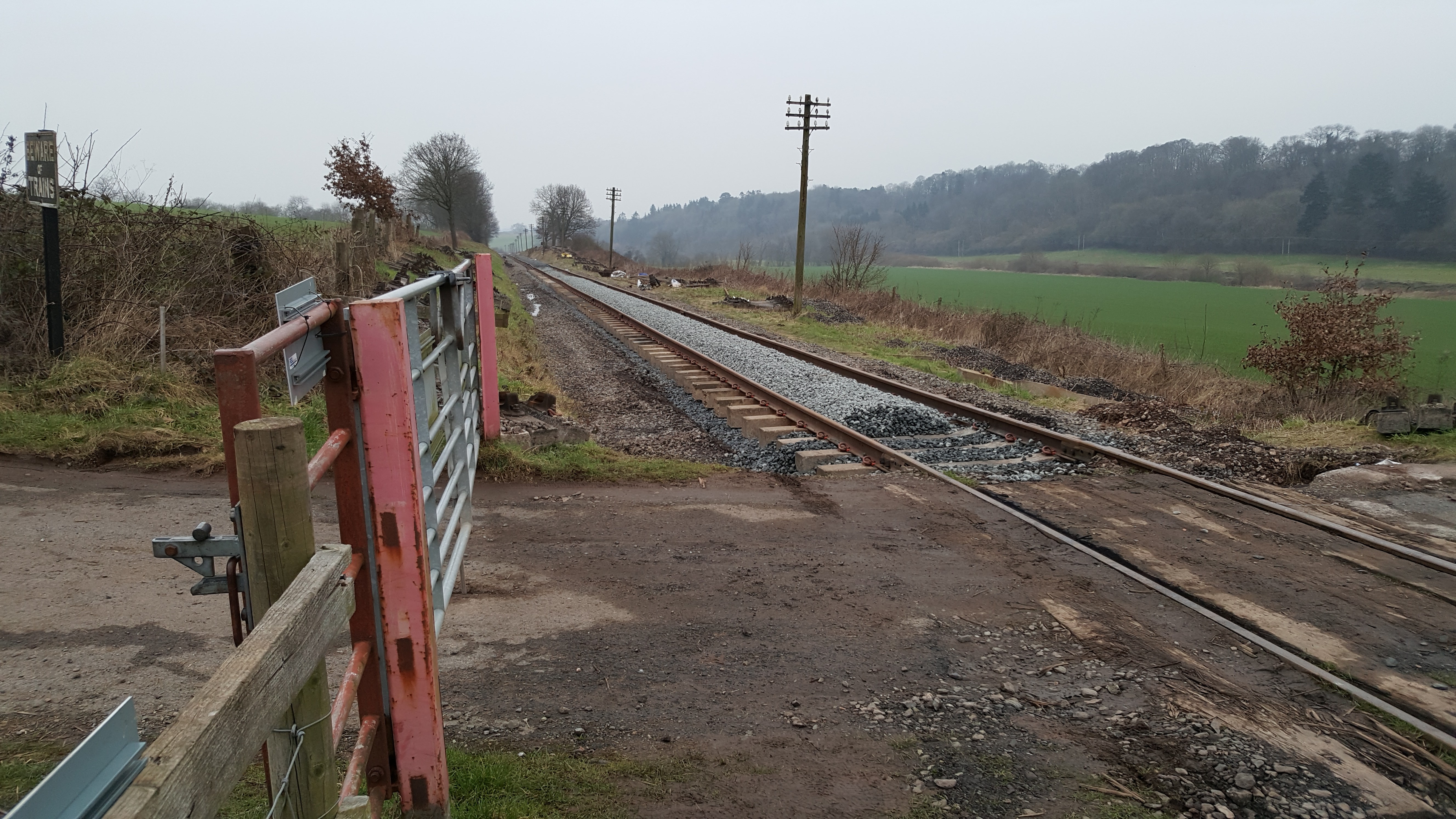 By 14th February the track is there at Waterworks with a sprinkling of ballast - more ballast and tamping in the next few days - as yet we don’t know whether there has been any more damage to the signalling cable. If you look closely at the track beyond the second telegraph pole it looks like aploughed field. [Photo: J. Smith]
A final reminder that this article, as well as other information on Signal Engineering, can be viewed in full colour here on the unofficial Signal Engineering web site.