 SVR S&T Dept.

SIGNALLING NOTES - Chris. Hall
The months of May, June and July have been very busy ones for us. The bracket signal ex Radyr Junction that was acquired with the assistance of the South East group of the SVRA more years ago than I care to remember had been languishing in the grass and brambles at Kidderminster for some time until the politics became favourable. We dismantled the spandrels and bracket lattice work - the ¾″ Whitworth bolts undid with only moderate persuasion after more than 50 years - so that the structure could be laid out in the compound, with the aid of the JCB, for shotblasting.
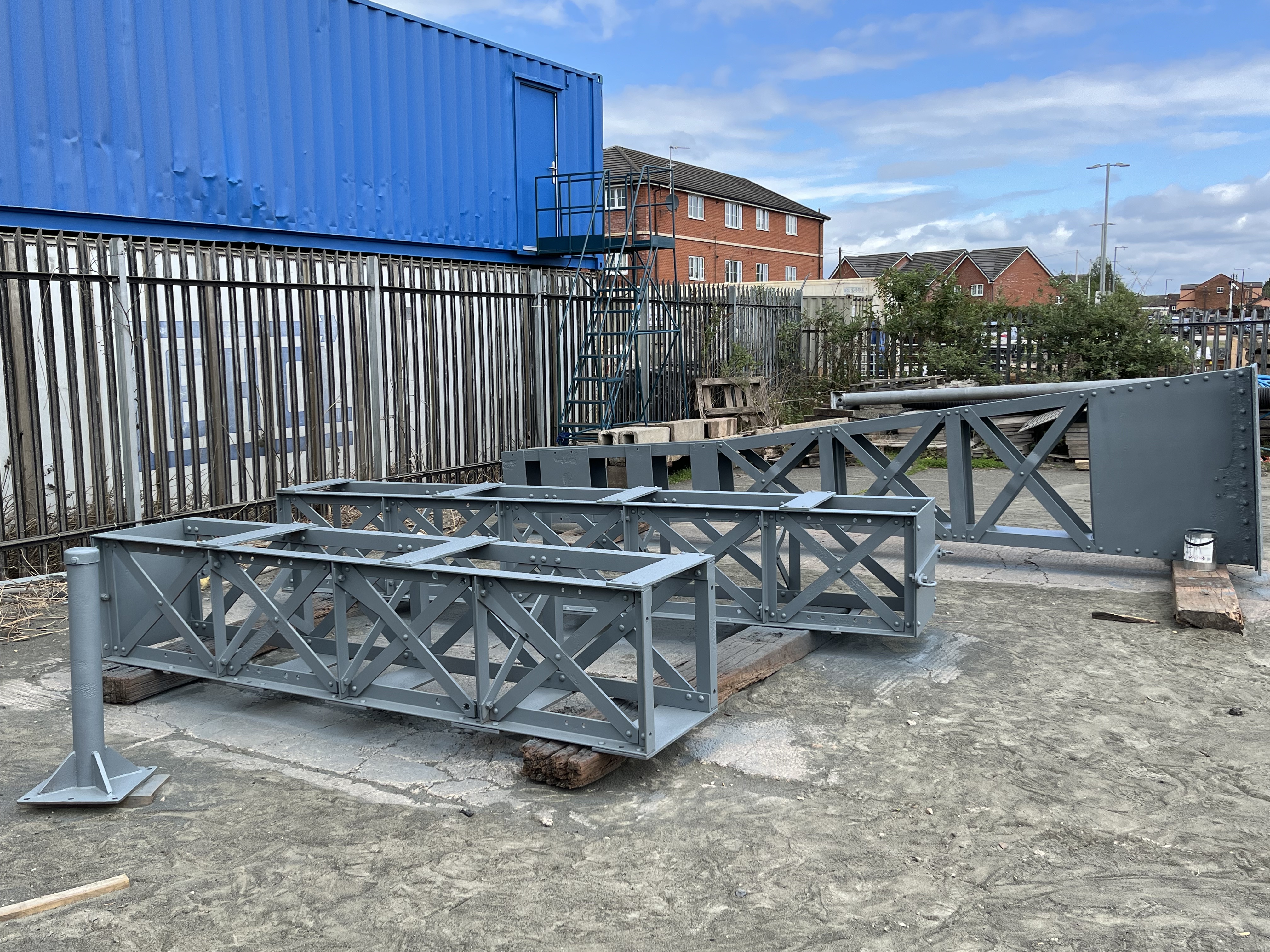 After shot-blasting on 1st and 2nd May the parts look like an Airfix kit, just rather larger and heavier. Primer has been applied to the accessible surfaces but they will need painting before assembly.
The JCB will be needed to turn over each part though and there is a lot of spent shot blasting sand to sweep up - a whole day‘s work for five of us on Sunday 4th May. [Photo: C. K. Hall]
After shot-blasting on 1st and 2nd May the parts look like an Airfix kit, just rather larger and heavier. Primer has been applied to the accessible surfaces but they will need painting before assembly.
The JCB will be needed to turn over each part though and there is a lot of spent shot blasting sand to sweep up - a whole day‘s work for five of us on Sunday 4th May. [Photo: C. K. Hall]
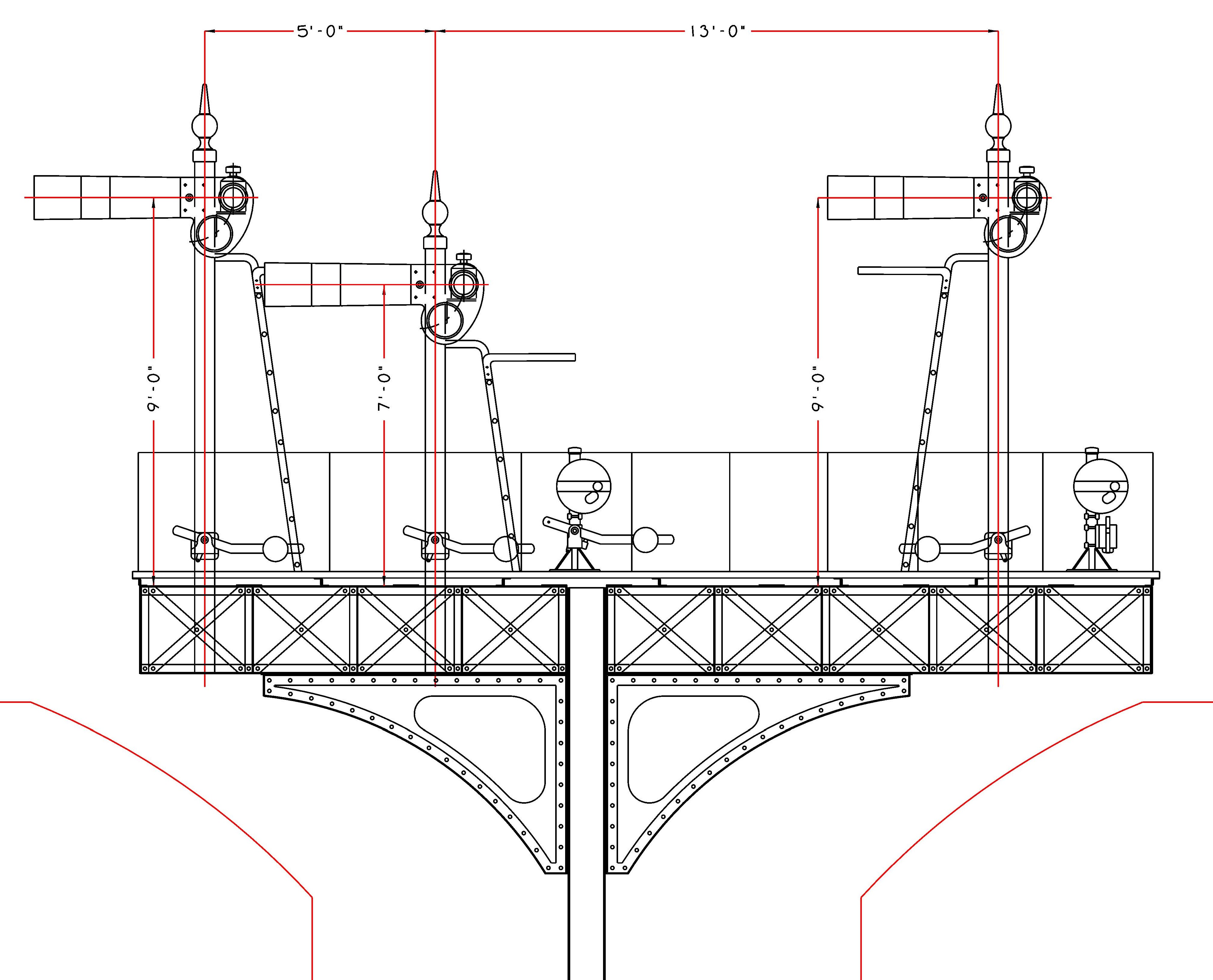 Unlike an Airfix kit, we have no assembly instructions, just the picture on the box showing what it should look like, Fortunately holes for the castings to hold the dolls in place all appear to be in exactly the right place and the platform 2 starting signal (no. 59) will appear in almost exactly the same position and elevation as the existing signal when viewed from the platform. [Diagram: P. Marshall
We had extracted from our stores three spindle castings, five balance lever castings and all the other small components required to equip the new signal, including cranks, signal arms, spectacle castings, backstop castings etc. We ordered timber for the decking, 5/8″ bright round steel for the handrail verticals and downrods (black round steel is no longer available in imperial sizes) and machined various other small components. Cutting several inches of thread on each end of nineteen handrail verticals was but a small task. We then embarked on an orgy of painting, red oxide, undercoat and gloss top coat. We now have a kit of parts ready for a trial assembly (on the ground) on 12/13 August. Unlike an Airfix kit, we’ll use ¾″ Whitworth bolts rather than polystyrene cement to put it together and will need the use of a JCB to lift each part into position.
Some months ago we ordered 6m³ of Readymix concrete (about 14½ tons) for delivery on 15 July and dug the hole for it on 14th July. Our spending has thus been about £3000 for this project, well within the budget for the refurbishment. We will need to order a road crane to install the new signal on 2 September as the 30 ton crane is now out of ticket which will represent an extra expense.
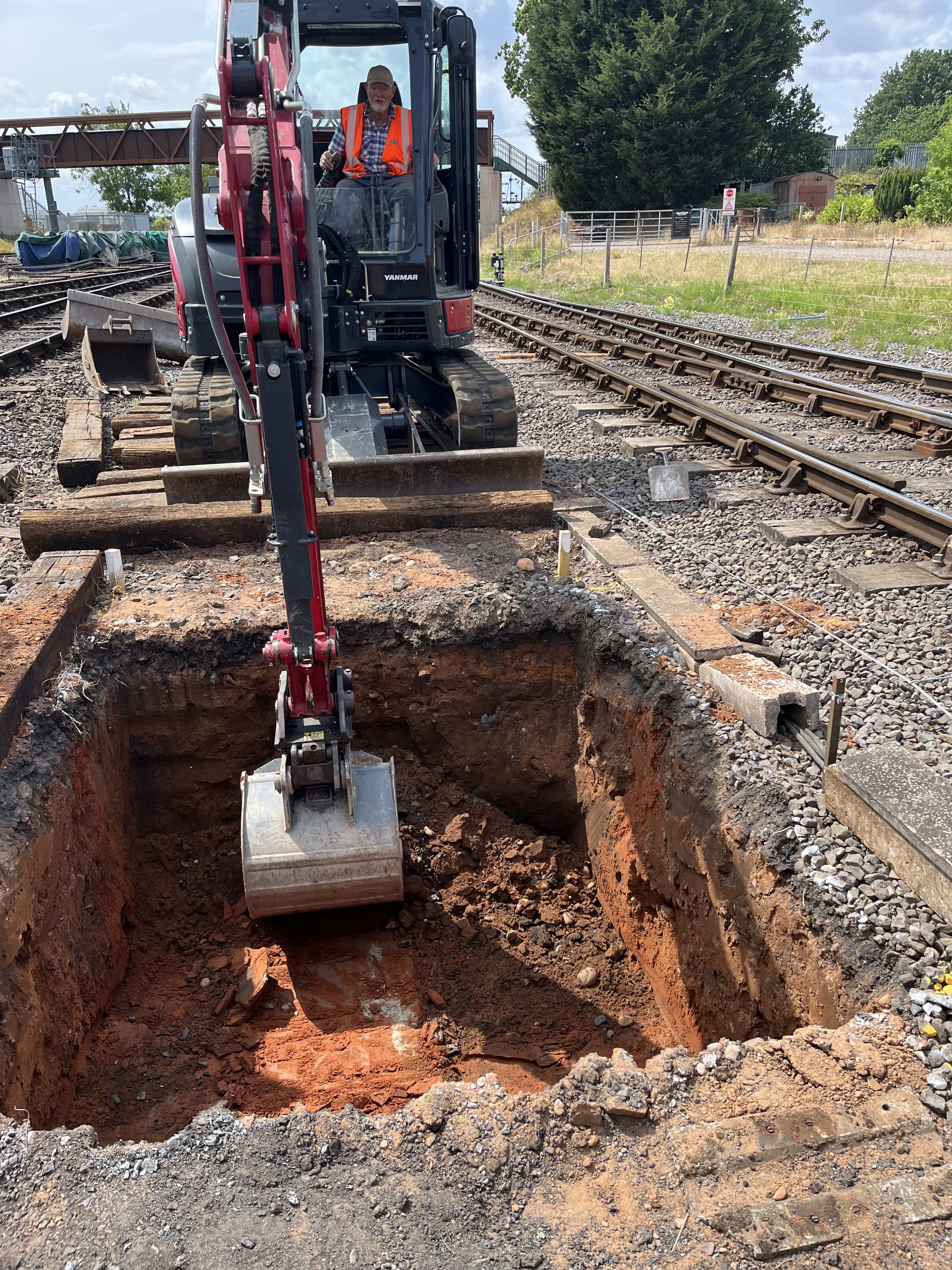 The hole is 2.05 m wide and Paul Marshall who is in charge of this work has a spreadsheet to work out its length (towards the digger) depending at what depth we hit solid sandstone, which proved to be at 1.2m below the top surface of the finished concrete, itself 8½• below rail level. The length was therefore set to be 2.4m so that about 5¾m³ of Readymix would nicely fill it. [Photo: C. K. Hall
 By 4pm on 14th the hole is prepared - a Heath-Robinson assembly uses some point rodding to retain the holding down bolts in the correct position. [Photo: C. K. Hall
 the largest delivery that comes with a conveyor is 6 cubic metres (about 14½ tons). [Photo: P.Marshall
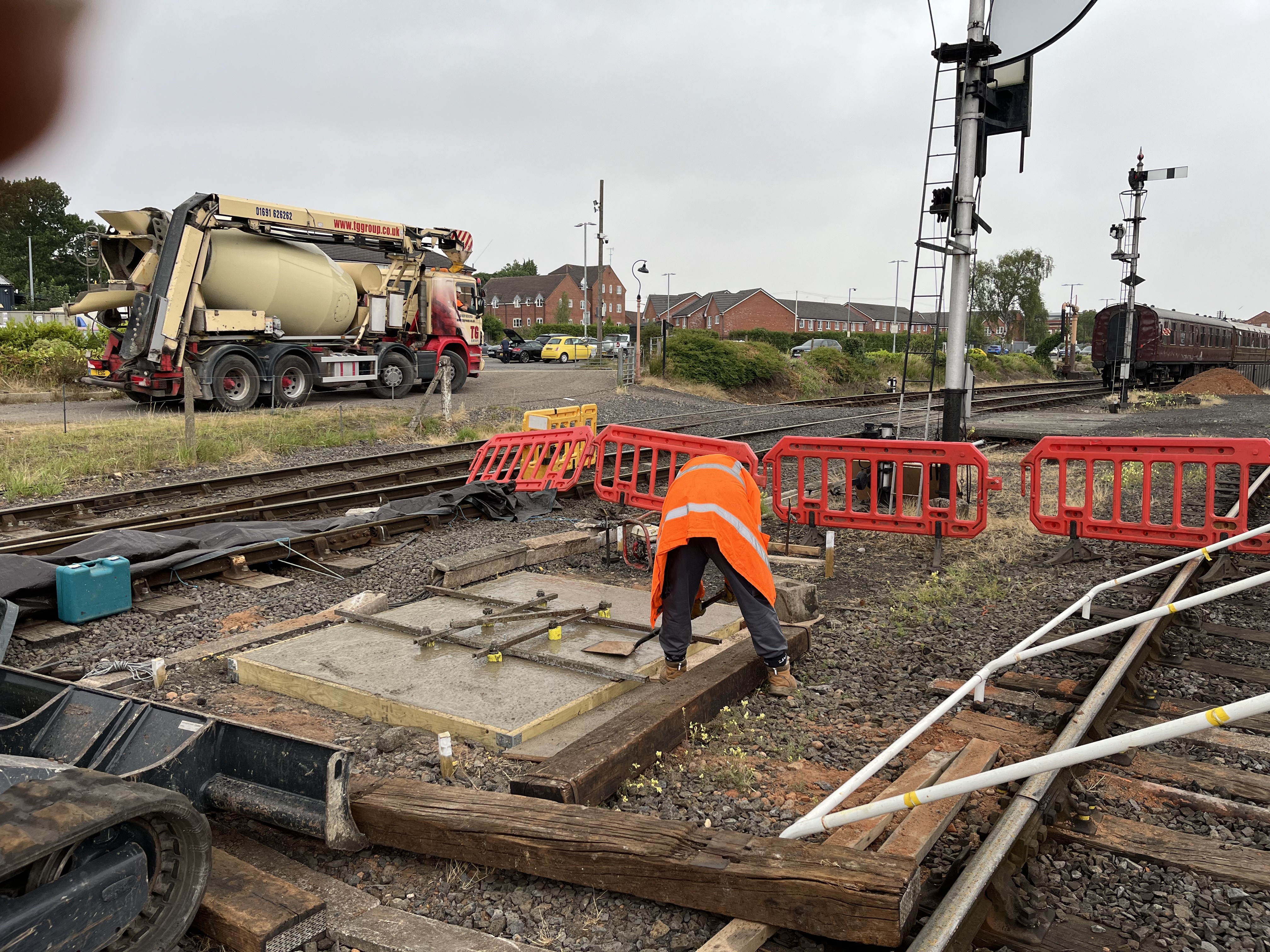 The hole is nicely filled and the Readymix lorry will wash out the remnants onto the pile of spoil removed from the hole. [Photo: C. K. Hall
Bending and marking up the 5/8• down rod to cut it to the right size (it has already had an �eye‘ welded to one end) was a whole day‘s work for four of us as it required a partial assembly of the signal. We used the shorter of the three dolls (10‘ rather than 12‘) and added two feet for the other down rods, making sure the offset was the right �hand‘ for each (7• from the post and 1½• sideways).
 assembling a 10 foot doll onto the lattice steel work was a nice challenge on 13 July. in order to measure the offset needed for the down rod and to work out the correct length.
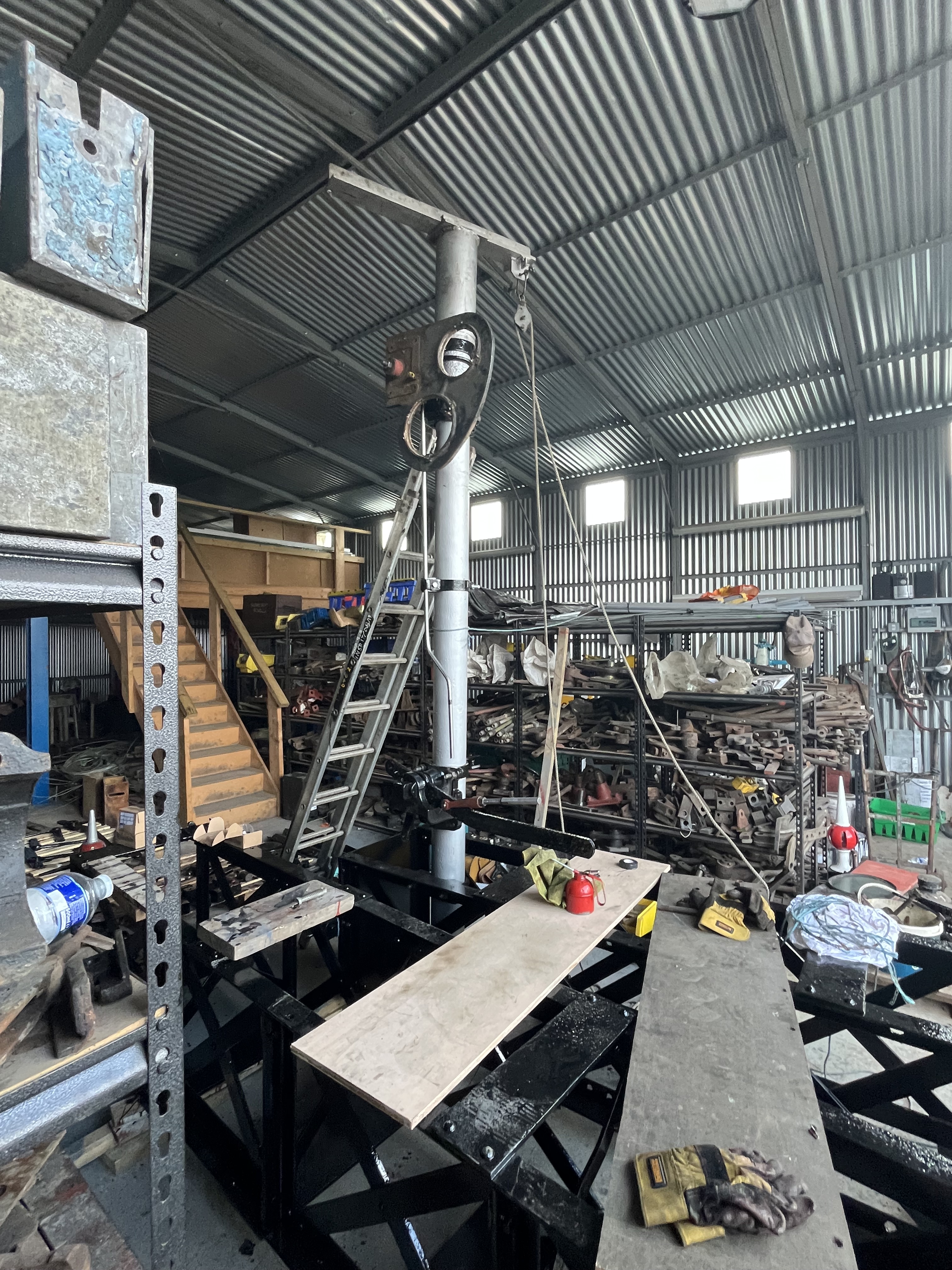 the spindle casting and spectacle casting are heavy and we have a purpose-built hoist to do this job.
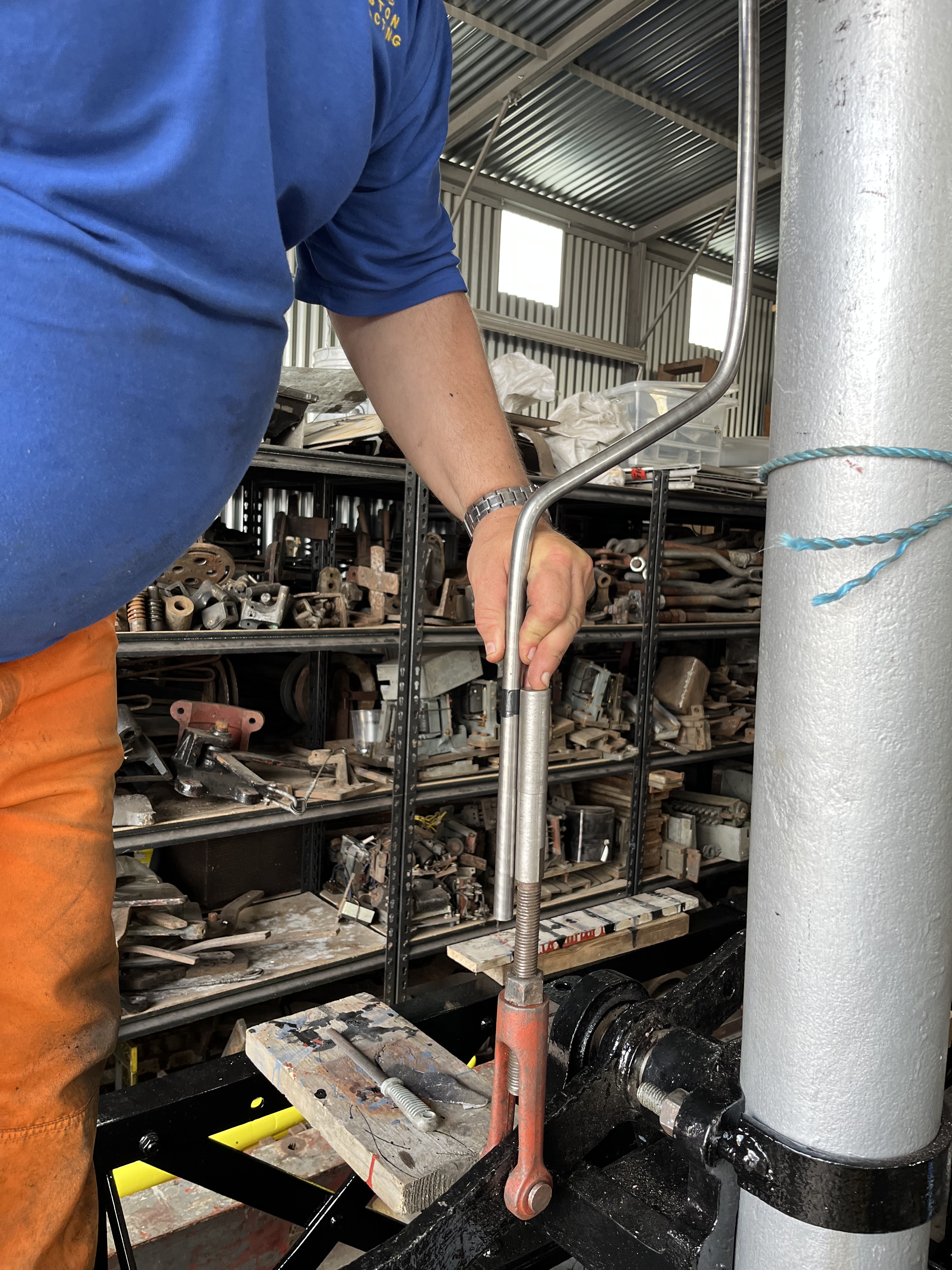 Martin Wood is holding the down rod in place to demonstrate the correct length for the downrod (marked with black tape) so that it can be cut and welded by 1501 group at Bewdley the following weekend Photos: C. K. Hall
By the time you read this in early October, the new platform starter bracket at Kidderminster will have been erected (road crane booked for 2 September) and commissioned (platform 1 side by 8 October) and platform 2 will then be out of use while the running line is realigned and 42B points moved closer to the footbridge to allow the platform to be extended.
Another task we had been quietly preparing for was the splitting of AL track circuit (Kidderminster platform 1) which is an unusual one: when 52 points are normal, this track circuit comprises just the �B‘ end (buffer stop end) of the crossover but when 52 points are reversed, then both the �A‘ end and the �B‘ end are in circuit and the points are locked reverse until the whole crossover is clear. After a shunt has been authorised to pass the Stop board into 1EL Dock the signalman puts a collar on the lever for 52 points as a reminder. The new arrangement has a track circuit �EE‘ monitoring the �A‘ end and the points cannot now be released unless both ends of the crossover are clear. The signal box diagram has been amended accordingly and signalmen advised. The new track circuit was commissioned on 14 July.
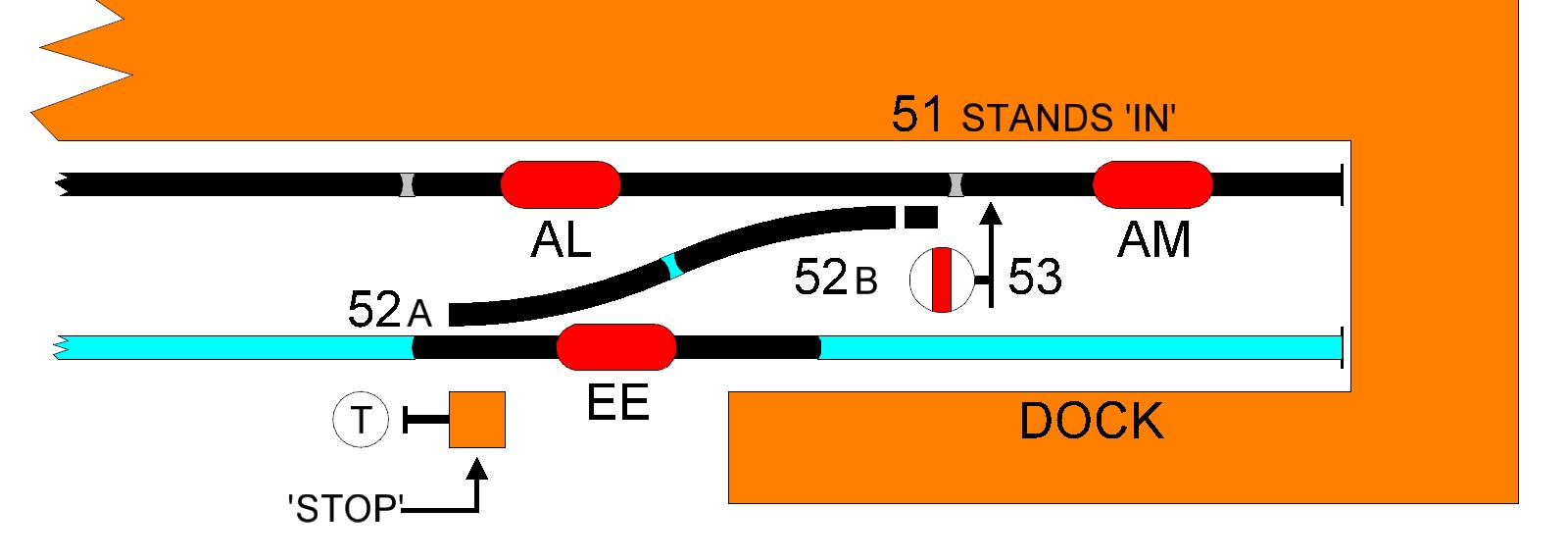 Box diagram amended accordingly. This takes five of us to gently ease the glass front away from the wooden case so that the diagram can be changed. The new diagram shows the new signal with a covering patch to show the existing arrangement which can be removed when the new signal is commissioned. [Diagram: P. Marshall
A reminder that this article, as well as other information on Signal Engineering, can be viewed in full colour here on the unofficial Signal Engineering web site.